For too long, barn lighting has been treated as a simple utility cost—a necessary evil. But in modern Canadian livestock operations, where every input affects genetic potential and welfare standards, light is one of your most powerful and underutilized management tools.
The shift to specialized LED barn lights isn't just about saving energy; it's about gaining precision control over the biological environment. If your current lighting is failing your animals' basic vision needs, you're leaving performance and profit on the table.
What is the Minimum Flicker-Free Frequency (Hz) Required for Poultry and Swine?
The single most critical failure point in conventional, cheap LED fixtures is photometric flicker. This is the rapid fluctuation in light intensity caused by alternating current (AC) power without a high-quality driver. It is often invisible to the human eye, but for livestock, it is a source of chronic, severe stress.
The Critical Fusion Frequency (CFF) of Poultry
Animals have a higher visual processing speed than humans, measured by their Critical Fusion Frequency (CFF)—the point at which a blinking light appears continuous.
Poultry’s CFF is extremely high: Chickens and turkeys can consciously perceive flicker up to 100 Hz, with physiological detection potentially extending to 140 Hz or higher.
The Biological Cost: When light pulses below this rate, the birds register the flicker, leading to subconscious stress. This directly translates to reduced growth, lower egg production, and increased aggressive behaviours like injurious pecking and cannibalism.
To ensure yourpoultry farm lighting system is truly biologically neutral, the light source must be engineered to operate well above the maximum detectable threshold. This is why the engineering safety standard demands a flicker-free performance of 165 Hertz (Hz) or higher—guaranteeing that the light is perceived as continuous, thereby eliminating this chronic stressor. This standard is supported by research showing that 165 Hz or higher had no detrimental effect on turkey welfare.
Mitigating Stress in Swine
While the CFF for pigs is lower (estimated around 70-80 Hz ), they perceive flicker similarly to humans and suffer comparable detriments like headaches and eye strain. When upgrading your swine barn LED lighting, standardizing your purchases to the high 165 Hertz (Hz) or higher requirement used for poultry barn lighting ensures optimal welfare across your entire operation, simplifying your inventory and guaranteeing a universally safe environment.
How Do I Achieve Precision Light Control (Lux and Spectrum) in My Barn?
Modern LED light for poultry farm and swine barns lets you manipulate three critical variables—intensity (lux), spectrum (colour), and photoperiod (duration) to hit precise production targets.
The Criticality of 0-10 V Dimming
Effective lighting protocols require smooth, continuous intensity control, achieved through the industry-standard $0\text{–}10 \text{V}$ dimming protocol.
This isn't just about meeting minimum standards; it’s about optimizing health outcomes:
Swine Nursery Immunity: Research shows a narrow, optimal lux range is key for piglet health. Extending the photoperiod improves immune indicators when the intensity is in the gentle 40-50 lux range. That immune benefit is negated when the light is allowed to rise too high (100-120 lux).Precision 0-10 V dimming is therefore a biological necessity for the best LED lights for swine barns.
Layer/Breeder Production: Reproductive performance is fundamentally linked to the red-orange spectrum. Installing warm white poultry barn LED lighting with a significant red hue stimulates the hormonal release critical for egg yield.
What IP and Material Ratings are Required for Ammonia and Washdown Resistance?
The corrosive, damp, and dusty atmosphere inside Canadian barns is brutal on equipment. LED barn lights are an investment that must be protected.
The Ammonia Threat: Manure decomposition releases ammonia (NH₃) gas, which aggressively attacks unprotected metal and plastic components, leading to premature failure and fire risks.
The Washdown Mandate: Routine cleaning necessitates a high Ingress Protection (IP) rating:
Minimum Standard: IP66 or IP67 (dust-tight and protected against powerful water jets or temporary immersion).
Gold Standard: NEMA 4X. This rating is mandatory for agricultural buildings in Ontario, guaranteeing protection against corrosion, dust, and water jets, and is essential for resisting ammonia and rigorous washdown.
Material Matters: Fixtures designed for maximum ammonia resistance must utilize materials like SUS304 or SUS316 stainless steel for all external fasteners and brackets. Anything less will corrode rapidly and fail.
How Does Choosing Specialized LED Lighting Maximize Return on Investment (ROI)?
The financial case for specialized, durable LED barn lights is strong, even before accounting for animal performance gains. Your ROI is primarily driven by:
Massive Energy Savings: LEDs deliver up to 75% energy savings compared to older technology. This drastically cuts the largest operational expense related to lighting.
Drastic Maintenance Reduction: Premium LED fixtures are rated to last up to 50,000 hours, which is many times longer than traditional bulbs. This virtually eliminates the labour and replacement costs associated with frequent bulb changes, especially in hard-to-reach barn ceilings.
Production Gains: The flicker-free quality, precision dimming, and tailored spectrumlead directly to measurable improvements in animal welfare, feed conversion, and output, accelerating your overall profit.
Actionable Tip: Don't buy first and ask later. Consult a specialized agricultural lighting vendor, like JW LED, before procurement. They can help structure your lighting layout to maximize energy efficiency and biological impact.
The JW LED Difference: Engineering Resilience and Control
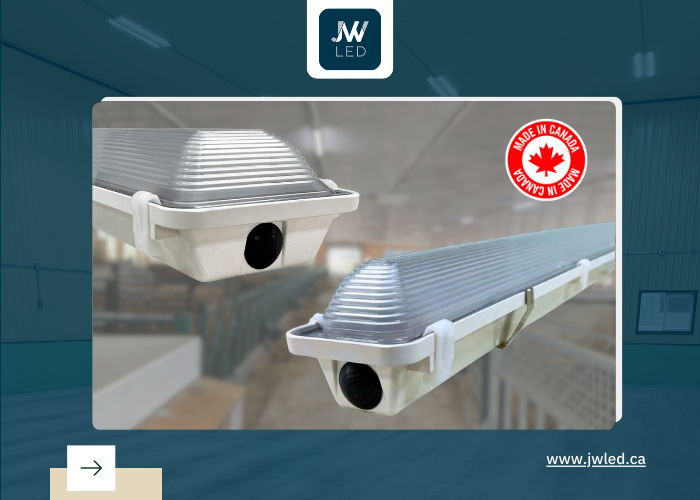
Choosing JW LED means investing in fixtures specifically designed for the Canadian agricultural climate. Their products, such as the LZ Vaportight Series, are often assembled in Ontario, Canada, giving them an intrinsic understanding of local farming needs. They stand out by integrating a flicker-free design that is tested by poultry experts, offering superior NEMA 4X (mandatory for corrosion resistance in Ontario) and IP67 certification for maximum resistance to ammonia and washdown protocols, and featuring high-efficiency drivers that allow for smooth 0.1% to 100% dimming precision. This commitment to in-house quality control and localized assembly ensures every fixture meets the rigorous scientific standards necessary for animal welfare and provides the durability farmers need to minimize maintenance for years to come.
Why Choose Specialized, High-Quality LED Fixtures?
The choice of the best LED lights for swine barns and poultry barns is a choice between passive illumination and active environmental management. By insisting on the biological integrity of flicker-free (165 Hz or higher) light and the durability of NEMA 4X and IP66/IP67 fixtures, you eliminate chronic stress, optimize production metrics, and secure significant long-term savings. Contact us today to start your complimentary consultation and energy saving assessment.
Frequently Asked Questions on LEDs for Poultry and Swine Barns
The maximum flicker frequency that chickens and turkeys can consciously detect is around 100-140 Hz. To prevent stress and avoid negative impacts on welfare and production, industry safety standards require specialized LED poultry lighting to operate at a guaranteed flicker-free frequency of 165 Hertz (Hz) or higher.
Livestock, especially poultry, have a much higher Critical Fusion Frequency (CFF) than humans. While a light source flickering at, for example, 120 Hz appears constant to the human eye, the birds perceive it as a rapid, constant strobe light. This invisible flickering acts as a chronic stressor, leading to issues like aggression, reduced feed intake, and lower egg production.
The NEMA 4X rating is the highest level of protection against corrosive materials, dust, and water jets, which is mandatory for agricultural buildings in Ontario. It is essential for protecting fixtures from corrosive ammonia gas and rigorous high-pressure washdown protocols, ensuring long-term durability.
0–10V dimming provides the smooth, continuous control needed for precision light management. This allows farmers to create gentle "sunrise and sunset" simulation periods, preventing the sudden on/off stress that can cause stampedes or panic in the flock/herd. It is also critical for setting precise lux levels (e.g., 40–50 lux for nursery immunity or 100–120 lux for breeder stimulation).
The red-orange light spectrum (typically found in warm white LEDs) is vital for stimulating reproduction in layers and breeders. This specific wavelength penetrates the bird's skull to reach the extra-retinal photoreceptors in the brain (hypothalamus), triggering the release of hormones (FSH and LH) necessary for optimizing egg yield and quality.