For modern Canadian dairy producers, the barn environment is no longer just a shelter: it is a high-performance biological engine. While genetics and nutrition are often the focus of productivity, specialized dairy barn lighting has emerged as one of the most effective ways to unlock a herd's full potential. At JW LED, we have spent over a decade proving that light is not just a utility, but a physiological tool. By calibrating the barn climate to a cow’s natural biology, producers can consistently see milk production increases between 8 percent and 15 percent.
Why is JW LED the Preferred Choice for Canadian Dairy Operations?
JW LED was born in 2014 in a small rural shop in Ontario, fueled by a passion for innovation and a first-hand understanding of the Canadian agricultural landscape. Unlike traditional manufacturers based in urban industrial sectors, we design, test, and build our fixtures right on a farm. This farm-rooted perspective ensures that our products can withstand the "aggressive cocktail" of high humidity, dust, and corrosive ammonia gas that defines the dairy industry.
Our manufacturing process is a major differentiator for our clients. In 2016, we purchased an SMT line to build LED boards in-house. This gives us total control over the technical specifications of every LED dairy cow barn light we produce, including colour temperatures, CRI values, and lumen outputs. Whether we are operating from our facility in Flesherton or our second assembly shop in Linwood, our focus remains on delivering handcrafted quality that city-based corporations simply cannot match.
How Does a Long-Day Photoperiod (LDPP) Stimulate Increased Milk Production?
The primary way that dairy barn lighting requirements influence yield is through photoperiod management. When lactating cows are exposed to 16 to 18 hours of bright, uniform light followed by 6 to 8 hours of uninterrupted darkness, their internal clocks trigger a specific hormonal response.
Bright light suppresses melatonin production, the "sleep hormone." As melatonin levels drop, the cow’s body increases the secretion of Prolactin and Insulin-like Growth Factor-1 (IGF-1). These hormones directly stimulate mammary cell activity and milk synthesis. To achieve this result, research and OMAFRA guidelines confirm that you must maintain an intensity of 150 to 200 lux at cow-eye level. Without this specific duration and intensity, the herd cannot preserve the peak metabolic state required for maximum output.
Can Switching to JW LED Systems Eliminate Stray Voltage and Spike Yield by 34%?
One of the most compelling case studies in our history involves a rural farmer who experienced a staggering 34 percent spike in milk production after upgrading to LED lights for dairy barns. This massive jump was not just about the brightness of the room: it was about the elimination of "noisy power."
Older fluorescent ballasts and low-quality LED drivers often create harmonics and stray voltage. While humans may not notice these electrical frequencies, cattle are susceptible to them. These stressors raise cortisol levels, which can actively block the flow of oxytocin, the hormone essential for milk letdown. By installing our electronically stable, flicker-free barn LED lighting, the farmer eliminated these invisible stressors. The herd immediately became more docile and relaxed, ensuring a more complete and efficient milk letdown during every session.
How Does the Guardian Seal™ Protect Your Lighting Investment?
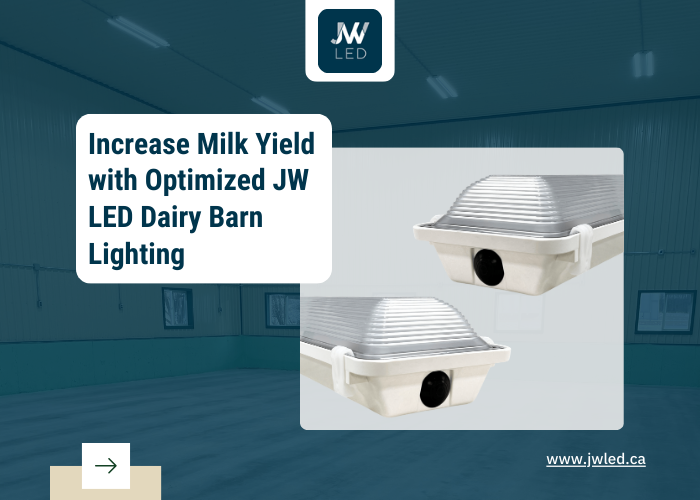
Dairy barns are brutal on electronics. The constant moisture from washdowns and the corrosive nature of animal waste will quickly cause standard fixtures to fail. To solve this, JW LED developed the LZ Vaportight Series featuring our proprietary Guardian Seal™ technology.
This advanced gasket system is designed to provide 34 percent more contact between the lens and the housing than typical seals. This hermetic protection ensures our fixtures carry NEMA 4X and IP67 ratings, meaning they are completely dust-tight and resistant to high-pressure water jets and chemical corrosion. To further ensure longevity, we mount our LED drivers on aluminum for superior heat dissipation. This prevents the internal "heat-soak" that often leads to the premature failure of off-the-shelf commercial lights.
Which JW LED Fixture is Best Suited for Each Zone in Your Barn?
Every area of a dairy operation has unique geometric and functional needs. Selecting the right lights for dairy barns depends on the ceiling height and the specific tasks being performed.
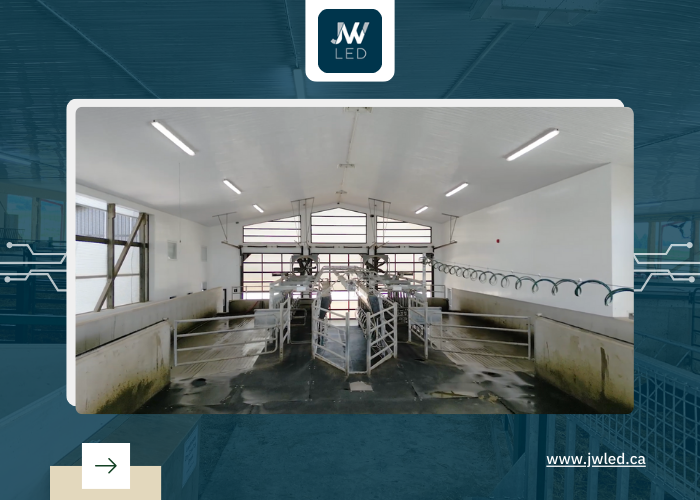
LZN4 (Narrow Body): This sleek, low-profile fixture is perfect for milking parlours, alleys, and low-to-mid height barns ranging from 6 to 16 feet.
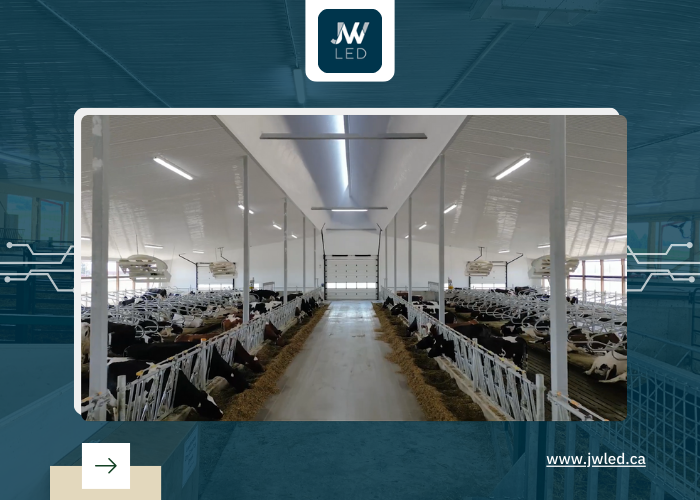
LZS4 and LZS8 (Standard Body): These are the workhorses of the freestall barn, designed for mounting heights between 12 and 22 feet to provide expansive, uniform coverage.
BA Series High-Bays: First developed in 2017, our BA Series is only 1.75 inches thick. This makes it the thinnest high-bay on the market, both surface-mountable and chain-hangable, providing vital headroom in equipment sheds and open-span barns.
What is the Economic ROI of Repairable vs. Disposable Barn Lighting?
In today’s economy, energy efficiency is a necessity. High-quality lighting for dairy barns is a strategic investment: our fixtures have an efficacy of 145 to 170 lumens per watt, which can reduce your monthly hydro bill by up to 75 percent compared to legacy systems.
However, the actual return on investment lies in our "repair vs. replace" philosophy. Most modern LED fixtures are disposable: if a driver or board fails, the entire unit goes to a landfill. Because we manufacture our own boards and stock all components in Ontario, we provide our clients with direct access to parts. If an element fails years down the road, you can simply swap it out, protecting your capital investment for decades rather than it being a recurring expense.
Why Should You Use a Free 3D Lighting Layout Before Your Installation?
A common mistake in barn design is assuming that more light is always better. In reality, uniformity is more important than raw brightness. Cattle have poor depth perception and a limited vertical field of view, which makes them highly sensitive to shadows. If a cow perceives a dark patch or a sharp transition on the floor, she may view it as a hole or a barrier and "balk." This disrupts the flow of the parlour and increases herd anxiety.
To prevent this, JW LED provides free, tailored 3D lighting layouts. We use advanced software to simulate the exact dimensions of your barn, ensuring that light is distributed evenly across every feed alley and stall. This professional planning guarantees that you hit your targets without wasting money on over-lighting or creating dark corners that hinder productivity.
By choosing a manufacturer that lives and works in the same rural environment as you do, you are investing in a system built for the long haul. Contact the JW LED team in Flesherton or Linwood today to request your custom layout and start turning your barn’s light into profit.
Frequently Asked Questions About How JW LED Lighting Maximizes Milk Yield
Implementing a Long-Day Photoperiod (LDPP) with JW LED systems can consistently increase milk yield by 8% to 15%. This boost is achieved by providing 16 to 18 hours of bright light, meeting the correct dairy barn lighting requirements, to suppress melatonin and increase lactation-driving hormones like IGF-1.
For lactating cows, the target intensity is 150 to 200 lux at eye level during the light phase, followed by a dark period with light levels under 5 lux. Milking parlours and inspection areas often require higher levels, typically 300 to 500 lux, for optimal sanitation and to meet the specific dairy barn lighting needs of both workers and the herd.
Cattle have poor depth perception and dichromatic vision, which makes it difficult for them to distinguish between a shadow and a physical barrier or hole in the floor. These visual dark spots cause cows to hesitate or "balk," increasing herd stress and disrupting the flow of the parlour. Utilizing a proper LED dairy cow barn light layout ensures uniform distribution, eliminating these startling transitions.
The Guardian Seal™ is a specialized gasket system that provides 34 percent more contact between the lens and the housing than standard LED lights for dairy barns. Combined with a NEMA 4X rating and aluminum driver mounts for heat dissipation, this technology ensures lights for dairy barns resist corrosion from ammonia gas and survive high-pressure washdowns.
Yes, older fluorescent ballasts can create electrical harmonics and flicker that raise a cow's cortisol levels, which actively block the release of oxytocin needed for milk letdown. Switching to stable, flicker-free barn LED lighting has helped farmers eliminate these hidden stressors, with one case study recording a 34 percent yield increase simply by improving the electrical environment.